> ## Documentation Index
> Fetch the complete documentation index at: https://checklyhq.com/docs/llms.txt
> Use this file to discover all available pages before exploring further.
# Laravel
> Learn how to instrument your Laravel code with OpenTelemetry.
This guide will help you instrument your Laravel application(s) with OpenTelemetry and send traces to Checkly.
## Step 1: Install the OpenTelemetry extension
```
pecl install opentelemetry
```
Check if the `opentelemetry` extension is properly installed and enabled:
```bash theme={null}
php --ri opentelemetry
```
You should see something similar to:
```bash theme={null}
opentelemetry
opentelemetry hooks => enabled
extension version => 1.0.3
Directive => Local Value => Master Value
opentelemetry.conflicts => no value => no value
opentelemetry.validate_hook_functions => On => On
opentelemetry.allow_stack_extension => Off => Off
```
If you are not getting a similar output, check your `php.ini` file and make sure a line is added similar to this:
```
extension=/some/path/opentelemetry.so
```
Now install the automatic Laravel instrumentation.
```bash Terminal theme={null}
composer require open-telemetry/opentelemetry-auto-laravel
```
## Step 2: Install the OpenTelemetry SDK
```bash Terminal theme={null}
composer require \
open-telemetry/opentelemetry \
open-telemetry/sdk \
open-telemetry/api \
open-telemetry/opentelemetry-auto-slim \
open-telemetry/opentelemetry-auto-laravel \
open-telemetry/exporter-otlp
```
Now install the automatic Laravel instrumentation.
```bash theme={null}
composer require open-telemetry/opentelemetry-auto-laravel
```
## Step 3: Initialize the instrumentation
This example shows all the code you will need to add to your `index.php`.
Notice the `ChecklySampler` class. This is a custom, head-based sampler that will only sample spans that are generated
by Checkly by inspecting the trace state. This way you only pay for the egress traffic generated by Checkly and not for
any other traffic.
```php index.php theme={null}
getContext();
$traceState = $parentSpanContext->getTraceState();
if ($traceState !== '' && $traceState !== null && str_contains($traceState, 'checkly')) {
return new SamplingResult(
SamplingResult::RECORD_AND_SAMPLE,
[],
$traceState
);
} else {
return new SamplingResult(
SamplingResult::DROP,
[],
$traceState
);
}
}
public function getDescription(): string
{
return 'ChecklySampler';
}
}
$exporter = (new SpanExporterFactory())->create();
$tracerProvider = new TracerProvider(
new BatchSpanProcessor($exporter, ClockFactory::getDefault()),
new ChecklySampler()
);
Sdk::builder()
->setTracerProvider($tracerProvider)
->setPropagator(TraceContextPropagator::getInstance())
->setAutoShutdown(true)
->buildAndRegisterGlobal();
// Bootstrap Laravel and handle the request...
(require_once __DIR__.'/../bootstrap/app.php')
->handleRequest(Request::capture());
```
## Step 3: Start your app with the instrumentation
Toggle on **Import Traces** and grab your OTel API key in the **OTel API keys** section of the [Traces page in the Checkly app](https://app.checklyhq.com/settings/account/traces) and
take a note of the endpoint for the region you want to use.
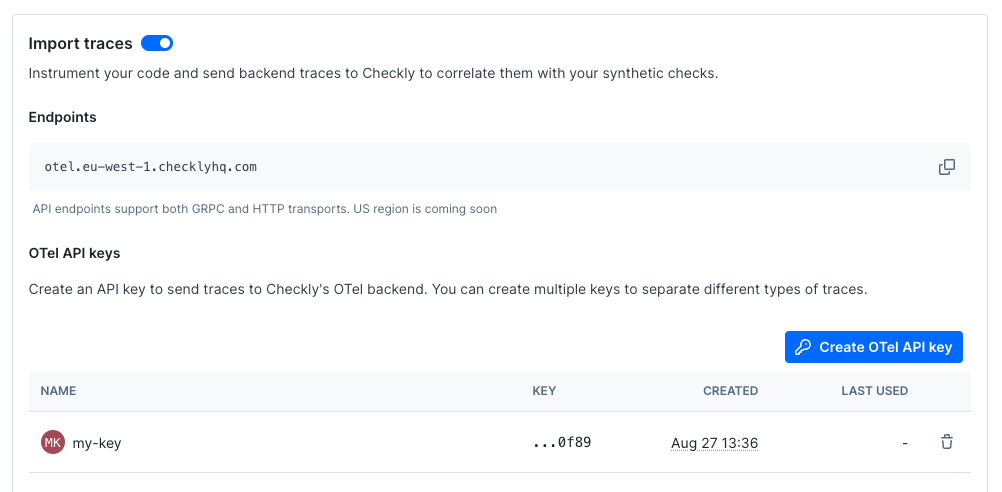 Now, export your API key in your shell by setting the `OTEL_EXPORTER_OTLP_HEADERS` environment variable.
```bash Terminal theme={null}
export OTEL_EXPORTER_OTLP_HEADERS="authorization="
```
Next, export the endpoint for the region you want to use and give your service a name.
```bash Terminal theme={null}
export OTEL_EXPORTER_OTLP_ENDPOINT="https://otel.eu-west-1.checklyhq.com"
export OTEL_SERVICE_NAME="your-service-name"
```
Then, explicitly set the protocol to use for the OTLP exporter.
```bash Terminal theme={null}
export OTEL_EXPORTER_OTLP_PROTOCOL="http/protobuf"
```
We are using the standard OpenTelemetry environment variables here to configure the OTLP exporter.
| Variable | Description |
| ----------------------------- | ---------------------------------------------------------------------- |
| `OTEL_EXPORTER_OTLP_HEADERS` | The `Authorization` HTTP header containing your Checkly OTel API key. |
| `OTEL_EXPORTER_OTLP_ENDPOINT` | The Checkly OTel API endpoint for the region you want to use. |
| `OTEL_EXPORTER_OTLP_PROTOCOL` | The protocol to use for the OTLP exporter. |
| `OTEL_SERVICE_NAME` | The name of your service to identify it among the spans in the web UI. |
Finally, start your app:
```bash Terminal theme={null}
php artisan serve
```
🎉 You are done. Any interactions with your app that are triggered by a Checkly synthetic monitoring check will now generate
traces, which are sent back to Checkly and displayed in the Checkly UI.
Now, export your API key in your shell by setting the `OTEL_EXPORTER_OTLP_HEADERS` environment variable.
```bash Terminal theme={null}
export OTEL_EXPORTER_OTLP_HEADERS="authorization="
```
Next, export the endpoint for the region you want to use and give your service a name.
```bash Terminal theme={null}
export OTEL_EXPORTER_OTLP_ENDPOINT="https://otel.eu-west-1.checklyhq.com"
export OTEL_SERVICE_NAME="your-service-name"
```
Then, explicitly set the protocol to use for the OTLP exporter.
```bash Terminal theme={null}
export OTEL_EXPORTER_OTLP_PROTOCOL="http/protobuf"
```
We are using the standard OpenTelemetry environment variables here to configure the OTLP exporter.
| Variable | Description |
| ----------------------------- | ---------------------------------------------------------------------- |
| `OTEL_EXPORTER_OTLP_HEADERS` | The `Authorization` HTTP header containing your Checkly OTel API key. |
| `OTEL_EXPORTER_OTLP_ENDPOINT` | The Checkly OTel API endpoint for the region you want to use. |
| `OTEL_EXPORTER_OTLP_PROTOCOL` | The protocol to use for the OTLP exporter. |
| `OTEL_SERVICE_NAME` | The name of your service to identify it among the spans in the web UI. |
Finally, start your app:
```bash Terminal theme={null}
php artisan serve
```
🎉 You are done. Any interactions with your app that are triggered by a Checkly synthetic monitoring check will now generate
traces, which are sent back to Checkly and displayed in the Checkly UI.