How DVAG Replaced Their Internal Synthetic Monitoring Tool With Checkly
Deutsche Vermögensberatung (DVAG) is Germany’s largest independent financial advisory firm, serving over 8 million clients across banking, insurance, and investment services.
With a nationwide network of advisors and deep integrations with partners like Deutsche Bank and Allianz, DVAG builds and operates complex digital workflows to support everything from contract creation to real-time customer interactions. Ensuring the reliability of these critical systems is key, not just for internal operations, but also for every advisor and client who depends on them.
300+
Performance issues found in POC
100+
Engineers Onboarded
80%
Reduction in MTTR
The Challenge
Before Checkly, Deutsche Vermögensberatungs (DVAG) IT Department built and maintained its own internal synthetic monitoring solution, developed over two years to support a wide range of test frameworks across multiple teams. But this custom tool, known internally as the RTF scheduler, came with growing challenges:
Initially, synthetic monitoring with the IT Department at DVAG was handled centrally, with one team maintaining scripts and infrastructure. As the organization grew, an effort was made to bring some tooling in-house to make it easier for developers to create their own monitors. Like many home-built solutions, it became clear that the operational overhead of maintenance would become too expensive.
DVAGs IT Department relied on a mix of tools, including Grafana, Azure, Prometheus, and internal systems, to track application health. While each served its purpose, getting a complete picture often meant switching between platforms, especially for non-technical stakeholders.
Before adopting synthetic monitoring, the IT Department had fewer proactive signals of issues, particularly in workflows involving third-party services. In some cases, problems surfaced through external feedback before internal teams could detect them.
DVAGs IT Department teams utilized a variety of testing frameworks, including Playwright, Ranorex, and Karate, each tailored to specific use cases. But with this flexibility came complexity: test frequencies, formats, and standards varied across teams, making it harder to create a unified monitoring approach.
Why Checkly?
DVAGs IT Department didn’t just need a tool. They needed a solution that would scale with their teams, support their infrastructure, and reduce long-term complexity. Here’s what stood out:
Checkly’s code-first approach made it easy for DVAGs IT Department to integrate synthetic monitoring into developer workflows. Developers could write, version, and deploy checks the same way they manage application code, removing the burden from centralized performance teams and avoiding manual UI setups.
Before Checkly, data lived in too many places. Managers had no way to self-serve information without asking engineers. With Checkly’s UI, non-technical stakeholders can now access the insights they need independently. No dashboards to configure, no queries to write.
Many developers at DVAG got up and running with Checkly within the week, thanks to internal documentation built around Checkly’s developer-friendly design. The learning curve is low, and teams could reuse their existing Playwright knowledge with minimal changes.
By removing the need to maintain their internal tool, DVAGs IT Department dramatically reduced the complexity of managing the monitoring infrastructure. Engineers now spend more time improving test quality and less time debugging flaky scripts, managing Kubernetes workloads, or troubleshooting Grafana panels.
The shift to Checkly has helped DVAGs IT Department detect hundreds of issues across their applications, long before they impact end users. For workflows tied to third-party services, Checkly provides visibility into problems DVAGs IT Department can't fix directly but still needs to track, like downtime or degraded performance from external banking APIs.
“We had tests that got deleted, and no one knew why. With Monitoring as Code, we just redeployed them. That wouldn’t be possible without it.
System Integration Specialist
After the IT Department at DVAG piloted Checkly, the platform team began a broader evaluation alongside their existing in-house monitoring solution. As the evaluation progressed, it became clear that Checkly could complement their efforts by offering a more streamlined and scalable approach to synthetic monitoring.
Checkly gave DVAGs IT Department a unified way to manage synthetic monitoring, without the operational overhead of building and maintaining infrastructure. Developers could define monitors as code, while operations and management teams could use the intuitive UI to investigate incidents.
Instead of scattering data across tools, Checkly plugs directly into DVAG’s Prometheus and Grafana stack, sending metrics and alerts into their existing workflows. With minimal setup, the IT Department was able to start detecting real issues within days.
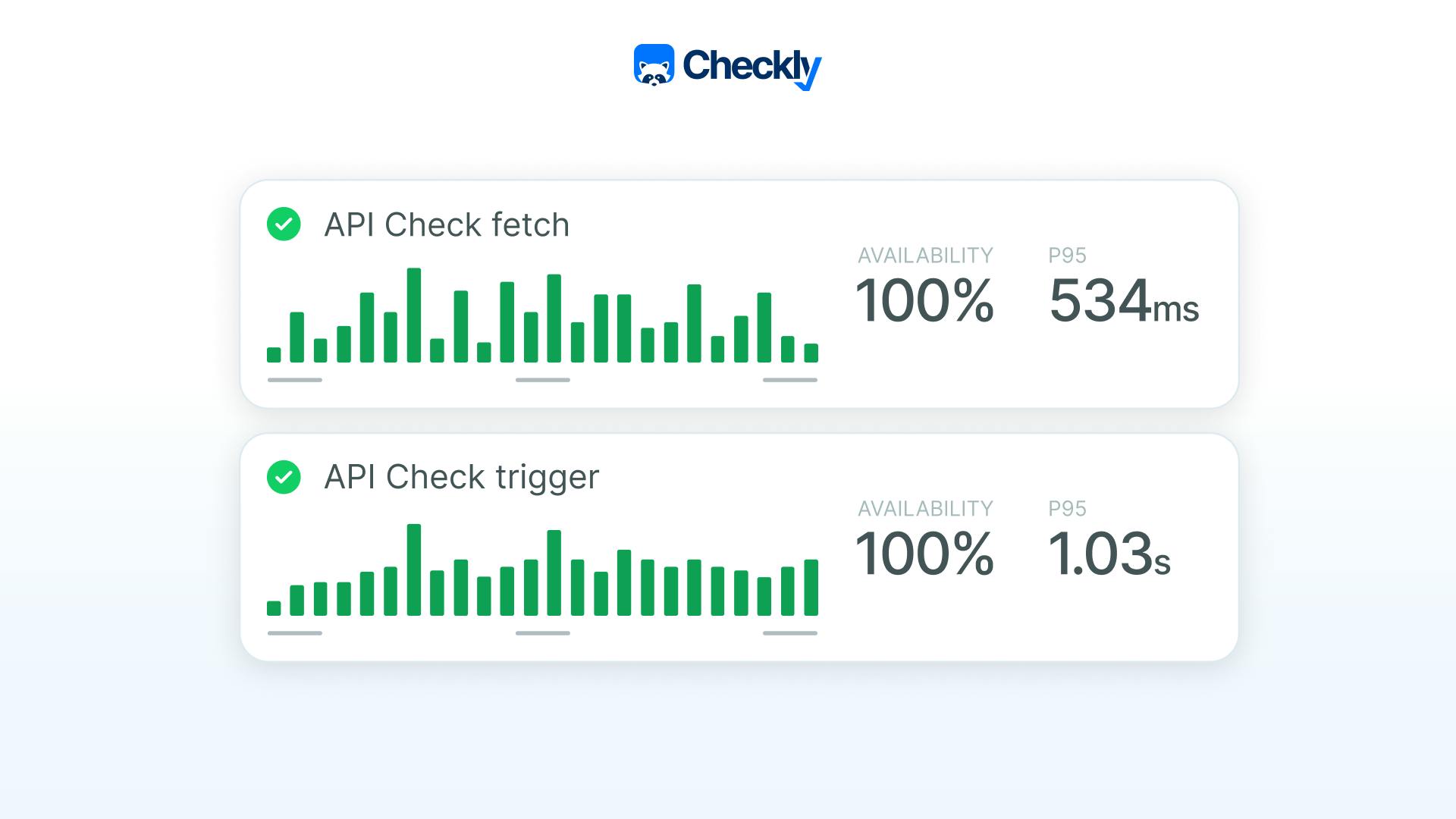
The move to Checkly has already paid off for DVAGs IT Department, even with only ~30% of applications fully onboarded:
- 300+ issues detected in the first five months of using Checkly
- Reduced troubleshooting time from hours to minutes
- Around 100 developers are onboarded, with approximately 50 actively using Checkly today
- Stable Infrastructure - DVAGs IT Department sees zero flakiness due to monitoring infrastructure after the migration
- Minimized false positives due to stable Playwright implementation
- Seamless integration into Prometheus, Alertmanager, and Grafana for metrics and alerting
“We definitely discovered issues faster. We used to spend hours troubleshooting. Now we already have the what and where—so we can go straight to fixing it.” – Joshua Bitterberg, System Integration Specialist, DVAG
DVAGs IT Department continues to expand its use of Checkly, with plans to onboard 20 more applications in the coming months. But they’re also looking ahead to leveraging Checkly’s latest innovations.
With Playwright Native Check Suites now available, the IT Department plans to eliminate the overhead of bundling custom dependencies into private locations. Teams will be able to reuse shared components, page objects, and test logic without version conflicts or branching complexity.
“Playwright Native Check Suites will help us get rid of version pinning issues and bundling logic in our private locations. It’s a huge step forward,” said Holger Waschke, Platform Engineer at DVAG.