Changelog

What's new in Checkly

Stay up to date with new features, improvements, and fixes.

Get this delivered straight to your inbox. Prefer a feed? Subscribe via RSS

Run Checkly from GitHub Actions with native CI feedback

The new checkly-action runs checkly test or checkly trigger straight from your workflow, with detached test sessions and results reported through GitHub Checks. Gate pull requests on Checkly results without burning Actions minutes waiting for runs to finish.

- uses: checkly/checkly-action@v1
  with:
    command: test

✓ 12 checks passed · reported via GitHub Checks

gRPC, SSL, and Traceroute monitors are generally available

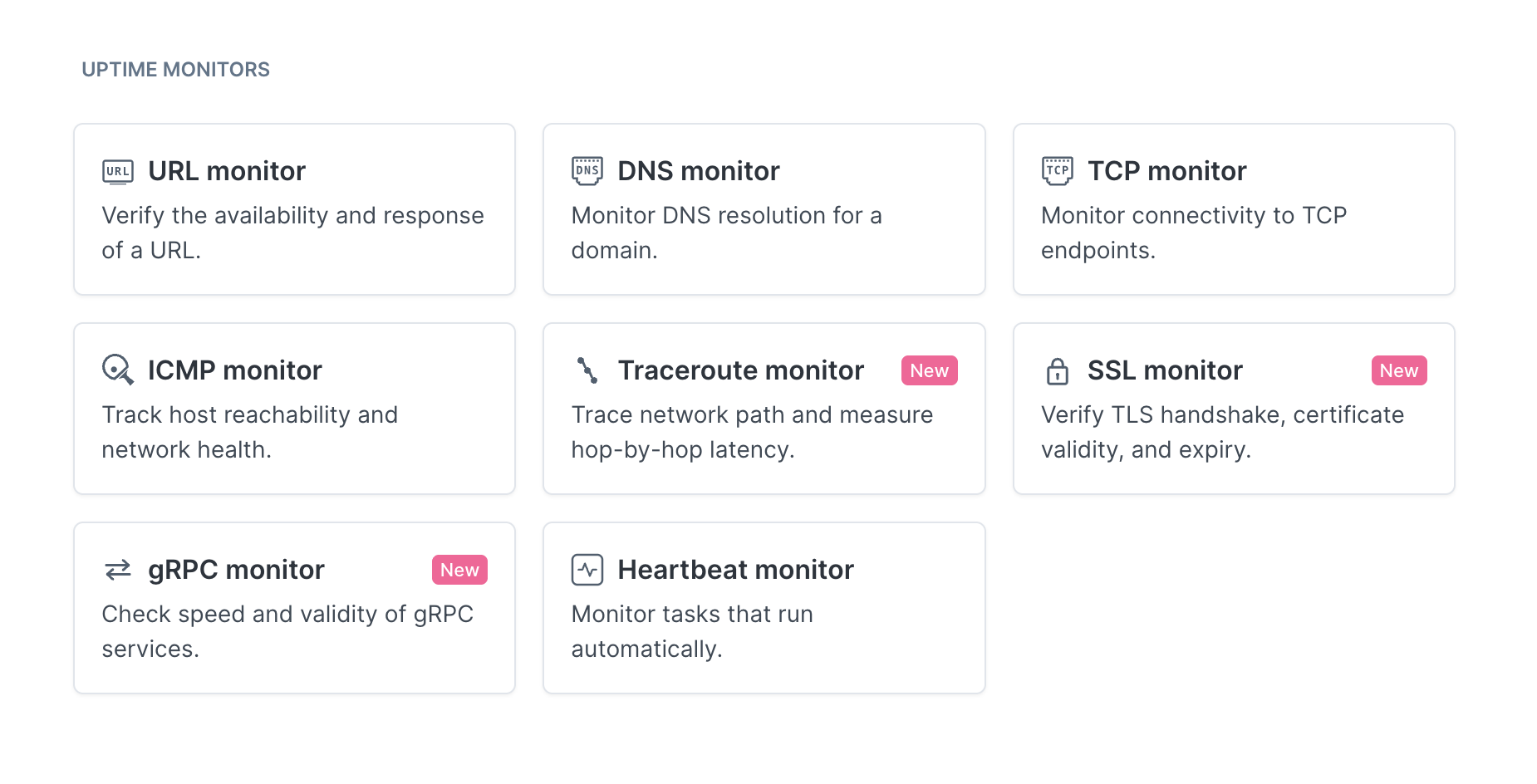
Three new monitor types, now available to everyone: check gRPC endpoints, catch expiring certificates, and trace network paths. Create and manage them from the web app, API, CLI, or your Monitoring as Code setup, with detailed assertions and diagnostics.

The uptime monitor picker with Traceroute, SSL, and gRPC monitors marked as new

Web Vitals in Playwright Check Suite results

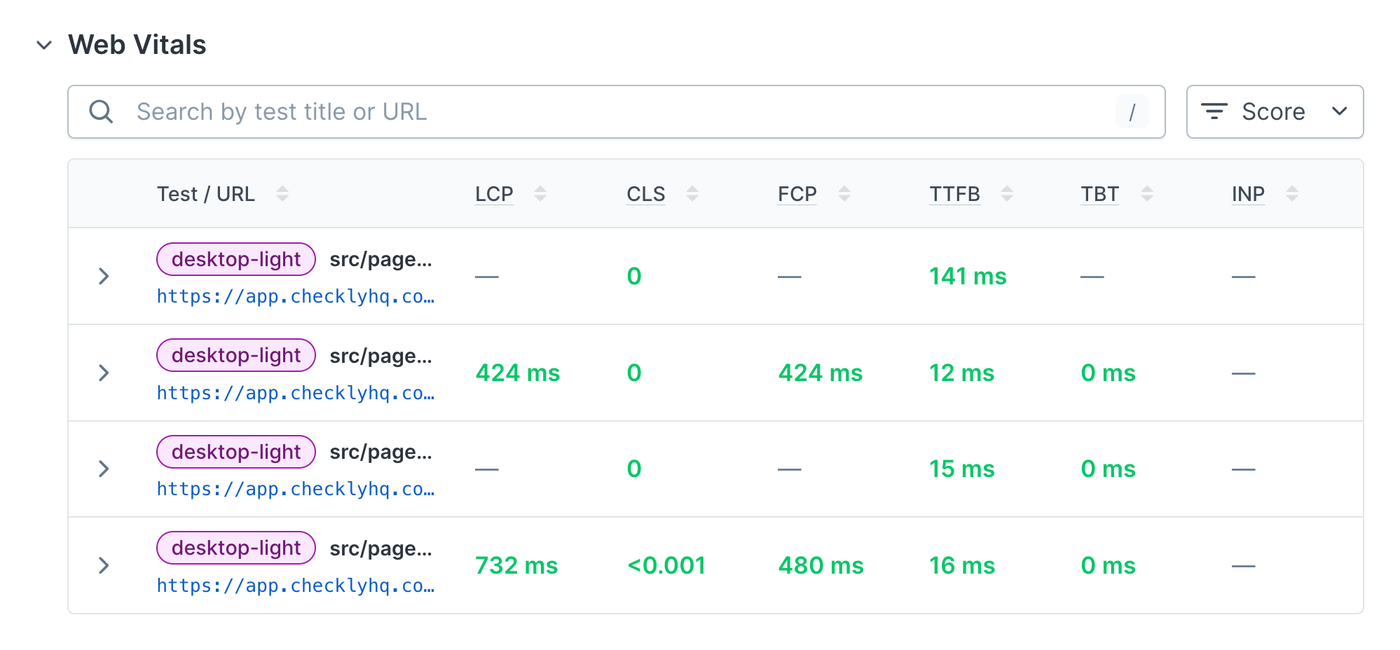
Playwright Check Suites now collect six Web Vitals for every page your tests visit — LCP, CLS, INP, FCP, TTFB, and TBT, scored against the web.dev thresholds. No changes to your tests needed: metrics show up per page visit in the same result view you already use for functional failures, and each LCP and INP score expands into a breakdown of where the time went.

Web Vitals table in a check result, listing each visited page with its LCP, CLS, FCP, TTFB, TBT, and INP scores

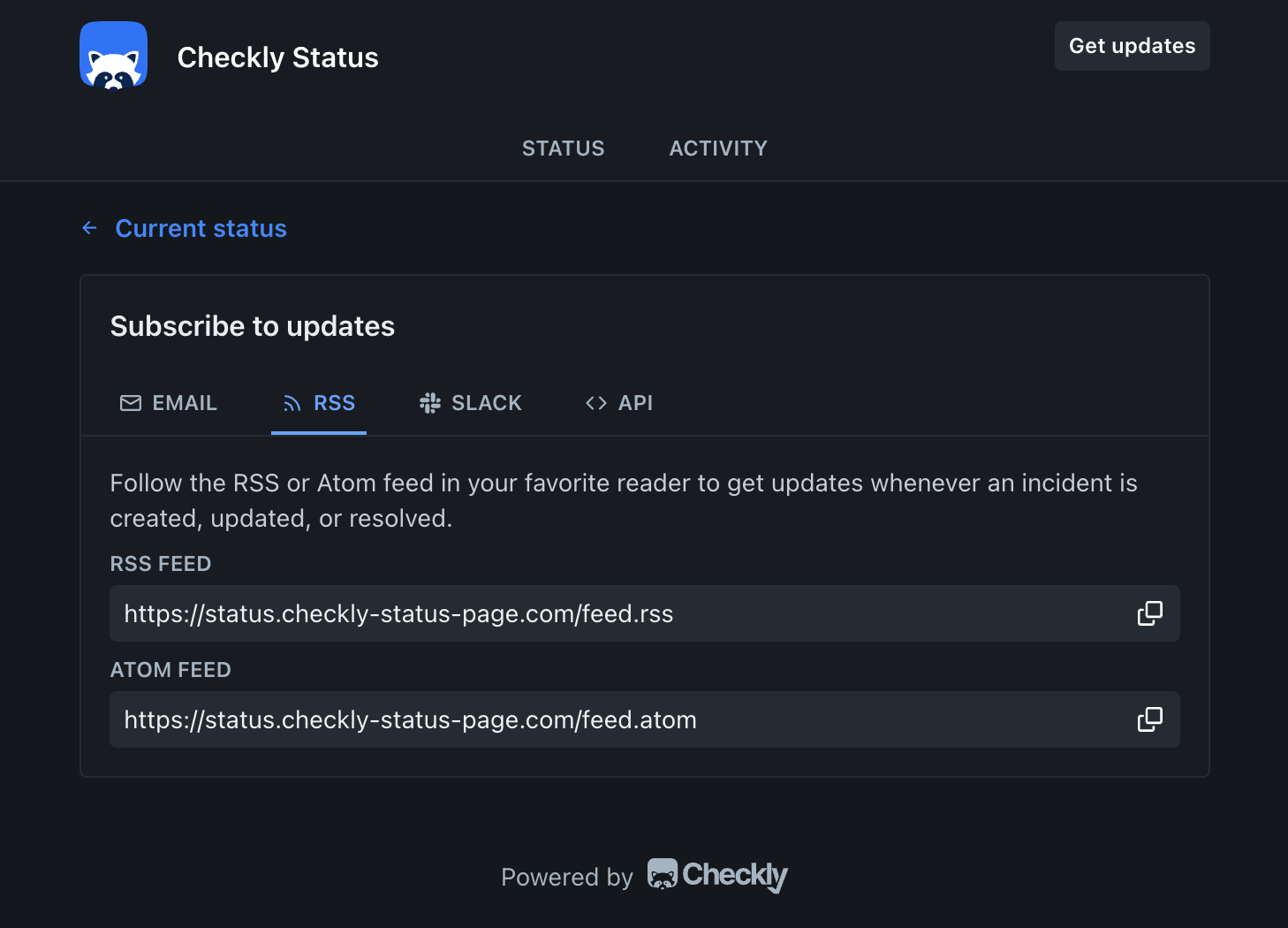
Status Pages now publish RSS, Atom, and Slack feeds

Every status page now exposes RSS and Atom feeds, and incident updates can flow straight into a Slack channel. Subscribers get incidents where they already work instead of refreshing a status page.

The status page Subscribe to updates card with Email, RSS, Slack, and API tabs, showing copyable RSS and Atom feed URLs

Also shipped

The Checkly MCP Server is here

The first version of the Checkly MCP Server is live. Point your AI client at the server URL and manage your monitoring from any MCP-capable agent — setup instructions per client are in the docs.

https://api.checklyhq.com/mcp

Download check artifacts straight from the terminal

No more digging through nested check-result JSON. checkly assets list and checkly assets download pull the artifacts of any check run or test session — logs, Playwright traces, videos, screenshots, reports — into your local folder.

Tag Manager: manage tags in one place

Rename tags everywhere they are used, delete unused or misspelled ones, and add tag descriptions that give Rocky AI extra context for root cause analyses. Available in the UI under Configuration.

The Checkly Slack app

Install the Checkly Slack app to receive alerts and rerun checks or AI analyses directly from Slack. It replaces webhook-based Slack alerts and comes with a new CLI construct.

Also shipped

More context for automatic root cause analysis

Rocky AI's root cause analysis now takes in two extra artifacts to determine why a check failed. It pulls in the last passing result for a failing check and diffs it against the failure to spot obvious regressions, and if you have Checkly Traces enabled, it pulls in relevant OpenTelemetry traces to correlate downstream errors with the failing check result.

Checkly CLI 8: ESM-only, cancellable runs, recording by default

CLI 8 ships three major changes: it is ESM-only (Node.js ^20.19.0 or >=22.12.0), CTRL+C now cancels test, pw-test, and trigger runs instead of burning quota in the background, and runs record by default unless you pass --no-record. Use -d for detached mode when you want a run to keep going.

npm i -D checkly@latest

Playwright Check Suites: faster runs, fewer false negatives

A batch of reliability work: cancellable queued and in-progress runs, custom runtime engines (Bun 1.7, Node.js 22/24/26), automatic retries for setup steps hit by transient network issues, browser caching in Private Locations, and full Playwright globalTimeout support.

Private Location metrics in the UI and Prometheus

See queue duration, agent count, and scheduled check runs for your Private Locations right in the UI — and spot over- or underprovisioned agents at a glance. The same metrics are available via Prometheus, so you can autoscale agents on Kubernetes with KEDA.

Alert channels now support environment secrets

Use {{MY_SECRET_VAR}} syntax in alert channel configs, so API keys and other sensitive values no longer live in plain text in the UI or API responses. Convert existing values with the new lock icon.

Also shipped

Cancel runs whenever you need to

Playwright Check Suite runs are now cancellable. You can stop queued or in-progress runs from the Playwright Check Suite Runs or Test Session Run pages, or press CTRL+C on Checkly CLI 8.0.0 and later. This works for runs started from Schedule now and for test sessions triggered via npx checkly test, npx checkly pw-test, and npx checkly trigger; cancelled runs show a Cancelled status in your run history.

Choose your Node/Bun runtime engine

Playwright Check Suites now support multiple Node.js and Bun engines, configurable from the UI or in code. Starting with Checkly CLI 8.1.0, the CLI reads your project's version files (.nvmrc, .node-version, .bun-version) and selects a compatible runtime automatically, with Node.js 22 (default), 24, and 26 and Bun 1.3 supported. You can override detection by setting the engine property on your PlaywrightCheck, for example engine: Engine.node('24').

Browser caching across runs in Private Locations

Check Suites now cache Playwright browsers across runs on the same Private Location agent, so the installation step is skipped entirely when a cached version exists. That means faster startup, no repeated downloads, and lower bandwidth usage, with zero configuration required. Caching is scoped per agent and available since Private Location agent version 8.2.0.

Also shipped

  • globalTimeout: Playwright's globalTimeout is now fully supported: set it in playwright.config.ts or via --global-timeout in your testCommand, and timeout errors now appear in logs and the Failures tab.
  • Setup retries: Environment setup steps prone to transient failures (pnpm install, Corepack, dependency cache downloads) now retry automatically with backoff, no configuration needed.
  • Dependency cache: The dependencies cache moved to a Least Recently Used cache, so all Playwright Check Suites now reuse and automatically refresh the same cache key instead of letting it expire.
  • Trace logs: Check logs now surface post-processing details, including report generation, trace processing, and trace sanitizing, each with its own timing.

ESM-only and updated Node.js requirements

The Checkly CLI is now distributed as ESM only instead of CommonJS, and CLI 8 requires Node.js ^20.19.0 || >=22.12.0. Make sure your local development, CI, and deployment environments run a compatible Node.js version before upgrading; your own projects can still use CommonJS. The CLI also switches its TypeScript loader from ts-node to jiti, which is now bundled as a direct dependency.

npm install checkly@latest

CTRL+C now cancels running Playwright Check Suites

Pressing CTRL+C during test, pw-test, or trigger now cancels in-flight test sessions instead of leaving them running in the background. If you want the previous keep-running-in-the-cloud behavior, run in detached mode with --detach or -d.

--record now defaults to true

The test and trigger commands now record results by default. To disable recording, pass --no-record; if your scripts relied on recording being off by default, update them before upgrading.

Also shipped

  • Engines: From CLI 8.1.0, Playwright Check Suites pick a compatible Node (22, 24, 26) or Bun (1.3) version from your project's version files, with an engine property to override detection.
  • .env files: The CLI now automatically loads a .env file when present; set CHECKLY_NO_DOTENV=1 to disable it.
  • Include patterns: Playwright check include patterns now resolve relative to your Playwright config file's directory instead of the project root, matching Playwright's own behavior.
  • RCA: checkly rca run now supports --test-session-error-group (-te) to trigger a Root Cause Analysis on Test Session Error Groups.

Use the OpenAPI spec instead

The old API spec at api.checklyhq.com/swagger.json is deprecated and frozen. Use the newer OpenAPI spec at api.checklyhq.com/openapi.json instead. The old file remains available for compatibility, but now carries a deprecation notice in its description and response headers.

Every failing assertion gets its own error group

Failing assertions on API, URL, DNS, ICMP, and TCP checks now produce individual error messages in Error Groups, instead of being consolidated under a generic "1 of 3 assertions failed". This means Rocky AI root cause analysis triggers when a genuinely new assertion failure surfaces, rather than staying silent because the failures looked alike. Live for all users on all plans.

Get started with the Checkly CLI using your agent

The new checkly init command sets up Checkly Skills, provides a prompt tailored to your project, and one-shots your monitoring suite with Claude Code, Codex, Cursor, or any other agent of your choosing.

# From ~/path/to/my-unmonitored-project/
npx checkly init

Runtime 2026-04 is here

The new runtime is available for Browser and Multistep checks, with upgraded Node.js and Playwright versions and updated built-in dependencies. Upgrade from your account settings; Private Location support starts with agent v7.

Playwright Check Suites: Bun support and smarter dependency caching

Run suites on Bun from CLI 7.11.0 onwards. Custom package manager versions are respected down to the patch version, dependency caches upload only on successful runs and invalidate automatically when your lockfile changes, and all four package managers show detailed install logs.

Also shipped

  • CLI: run and view Rocky AI root cause analyses with checkly rca run and checkly rca get.
  • CLI: detach resources from a project while keeping them in your account with --preserve-resources for destroy, and force fresh dependency installs with --refresh-cache.
  • Playwright Reporter: error groups now include suite runs from the reporter, for AI-powered error visibility across npx playwright test runs (Reporter 1.10+).
  • Uptime monitoring: a dedicated lightweight agent image for uptime monitors, plus DNS and ICMP support on Private Locations from agent v7.
  • Checks: add context with check descriptions — runbooks, team and service ownership notes — and filter checks by creator on the reporting page.
  • Starter plans: now include single retries for uptime monitors, helping catch intermittent failures.

Playwright 1.58.2 and Node.js 24.13.1

Runtime 2026.04 brings Playwright v1.58.2 and Node.js v24.13.1 to Browser and MultiStep Checks. Head to Account settings > Runtimes to select it or make it your default; the runtime documentation lists the full spec with all 67 included packages.

Seven new dependencies

We added axios-cookiejar-support, csv-parse, imapflow, mysql2, pdf-parse, tough-cookie, and winston to the runtime, covering persistent cookie handling, CSV parsing, IMAP inbox monitoring, a modern MySQL client, PDF text extraction, and structured logging. We also removed jsdom; for DOM interactions, use Playwright's built-in Page APIs instead.

Also shipped

  • Private Locations: Runtime 2026.04 is available on Checkly Agent 7.0.0, which ships with VM2 3.10.5 for tighter security; update your agent to 7.0.0 or later to unlock this runtime.
  • Performance: The updated VM2 security layer adds stricter sandboxing, so Browser checks may run slower compared to previous runtime versions; improvements are planned in upcoming releases.

ICMP monitors join Checkly's stack

Checkly now supports ICMP monitors on all plans, letting you continuously ping hosts to measure reachability, latency, and packet loss across regions. This helps teams detect connectivity issues early and understand network performance before it impacts their applications.

Faster incident debugging with Rocky AI

Rocky AI, Checkly's AI agent, is now generally available on all plans. Its automated Root Cause Analysis analyzes failing checks and tests, investigates artifacts like traces and PCAP files, and summarizes the likely root cause so teams can debug issues faster.

Playwright Reporter 1.8: a major upgrade

The Checkly Playwright Reporter got a major overhaul. It now captures richer debugging data from Playwright runs, including traces, logs, network activity, and performance metrics, making it easier to debug CI failures without digging through artifacts.

Agent-friendly CLI

The Checkly CLI is now built for AI agents. Across v7.3.0 to v7.7.0 we shipped a skills-based self-discovery system via npx checkly skills, read-only commands to list and inspect checks, full incident lifecycle management from the terminal, and a confirmation protocol for safe agent-driven write operations. Recent additions include analytics stats from the terminal, a built-in checkly skills install command, and checkly account plan to let agents understand your plan's features.

Also shipped

Copy a prompt, get a working config

We added a Copy prompt button to the Playwright Check Suites onboarding. Paste the prompt into your AI coding tool (Claude Code, Cursor, Copilot) in the context of your repo: it reads your Playwright setup (projects, test files, base URLs, dependencies), generates check suite definitions grouped by project and tags, iterates until the config looks right, and deploys once you are ready. You get a working checkly.config.ts without writing one from scratch.

Also available for Test Sessions and the Playwright Reporter

The same copy-paste flow works for Test Sessions and Playwright Reporter setup, with a different prompt for each.

A production-ready reporter for Playwright

The Checkly Playwright Reporter runs alongside your Playwright tests, captures execution data (logs, traces, network activity, console output, performance metrics), and uploads it to Checkly so your team can debug runs without digging through CI artifacts or trace files. It works locally and in CI, and now automatically scrubs sensitive values from reports and trace files, with full control via scrubbing options like envVars, autoDetect, and replacement.

Getting started takes about a minute

Install the reporter, export CHECKLY_API_KEY and CHECKLY_ACCOUNT_ID, add createChecklyReporter() to the reporter list in your playwright.config.ts, and run npx playwright test. Then open the run in Checkly to explore traces, logs, network requests, console output, and performance data.

npm install --save-dev @checkly/playwright-reporter

Also shipped

  • Run summary: Colour-coded [project] indicators while tests run, plus a per-project breakdown in your terminal with deep links to traces and full results in Checkly.
  • Performance: The Suite Performance Graph shows CPU and memory usage over time, broken down by Playwright project, to help find memory leaks and right-size CI machines.
  • Git detection: Branch, commit SHA, and author are auto-detected in CI and locally, with no configuration.
  • Debugging: Step reports now include root cause analysis by Rocky AI, the exact source line with surrounding context, and direct trace, snapshot, screenshot, and video assets.
  • Network data: Network requests now include domain, resource type, headers, timing, and transfer and resource bytes; resource type is derived from Content-Type when the browser does not provide it.
  • Run logs: The test command is auto-detected and shown in the Checkly UI, and job logs from the run are uploaded for review and sharing.

ICMP monitoring is here

ICMP monitors are now available on all plans. They continuously ping your hosts with ICMP Echo Requests to measure reachability, latency, and packet loss across regions, so you can verify that hosts not exposed to the public internet stay reachable, catch network-level outages early, and compare latency geographically. Set your ping count and packet loss thresholds, and optionally add assertions on latency or packet loss.

Fully integrated with Monitoring as Code

ICMP monitors work in Checkly's Monitoring as Code workflows via the IcmpMonitor construct, available in the CLI from v7.1.0. Terraform support ships in provider v1.18.0 with the checkly_icmp_monitor resource; Pulumi (v2.8.0) is not yet supported.

Smarter alert notifications with Rocky AI

Rocky AI, Checkly's AI agent, automatically analyzes, categorizes, and summarizes failures from your monitors and synthetic checks. You can now receive a root cause analysis directly in your inbox, Slack, Teams, or any other alert channel the moment a check fails. This is live for all plans; enable it in the Rocky AI settings.

Playwright Check Suites improvements

Playwright Check Suites now detect pnpm and npm workspace structures and install the correct dependencies automatically, resolve package.json exports during bundling, and support .tsx and .jsx files. npx checkly pw-test is now GA with new --installCommand and --include flags, checks install all dependencies from your package.json (not just devDependencies), and the dependency cache refreshes automatically when your install command or working directory changes.

Dashboard revamp: compare checks more easily

Dashboard charts now display data based on the selected time range, so all checks on a dashboard share the same timeline, making it easier to compare results across services. Group names now appear next to check names where applicable, and you can save dashboard views based on your filters and search; saved views are personal and shareable via URL.

Checkly Agent: health probes and heartbeat monitoring

The Checkly Agent now exposes /-/readiness, /-/liveness, and /health endpoints on port 8080 for Kubernetes readiness and liveness probes. The agent also sends a heartbeat to the Checkly platform every 2 minutes with built-in retry logic, so Checkly can detect when a private location has no connected agents and notify your team via email, and a /metrics endpoint exposes agent-level Prometheus metrics like check slot utilization and job processing duration.

Also shipped

Workspace support for Playwright Check Suites

Playwright Check Suites now work with monorepos. If your project uses pnpm or npm workspaces, Checkly detects your workspace structure, uploads the relevant files, and installs the correct dependencies automatically, with no extra configuration. Shared utility packages are detected and included, workspace:* dependencies resolve correctly, and only the files and workspace packages your check suite needs are uploaded, not your entire repo.

Get started with the latest Checkly CLI

Workspace support is available starting with Checkly CLI v7.1. Update to the latest version, or run npm create checkly@latest if you are new to Checkly and prefer a guided setup.

npm install checkly@latest

Rocky AI root cause analysis for all check types

Rocky, Checkly's AI agent, can now analyze and triage failures for all uptime monitors and synthetic check types, including trace routes, packet captures, and other artifacts generated during a check run. You get error classification (code typo or infrastructure error), user impact (which user groups or features are affected), and root cause with supporting evidence and, where possible, a simple code fix.

Dev agent image for Private Locations

A new dev variant of the Private Location agent image is designed for checks that rely on npm packages with native dependencies requiring compilation. It works the same way as the standard agent but includes the build tools needed to compile native modules, and is available starting with version 6.3.0.

checkly/agent-dev:X.Y.Z

New role: Read & Run

Read & Run is a new role for users who need to run checks and tests without being able to change configuration. Members with this role can view all resources and manually trigger checks via the UI, API, or CLI, while deployments and config changes stay locked down.

Also shipped

Archive

Older editions and release posts, in full on their own pages.